
144Hz, 120Hz, or 60Hz? What Actually Makes a Gaming Monitor Worth Buying
Choosing the right gaming monitor is not just about high numbers. Here is what refresh rate really changes, who needs 144Hz, and when 60Hz or 120Hz still makes sense.
HARDWARE TIPS
MundialGame
4/21/20263 min read
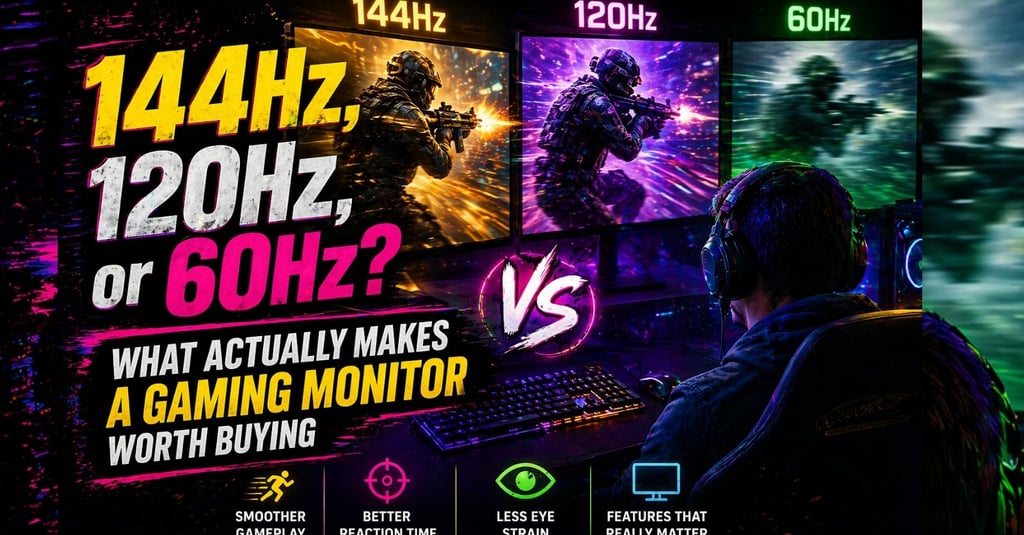
A lot of players buy gaming monitors by looking at one number and one number only: refresh rate. The higher the number, the better the monitor must be, right?
Not exactly.
Refresh rate matters, but it is only one part of what makes a monitor good for gaming. Some players overspend on 144Hz or 240Hz screens they cannot really use, while others ignore refresh rate completely and end up with a setup that feels worse than it should.
If you want to buy the right gaming monitor, you need to understand what refresh rate actually changes and when it is worth paying more.
What refresh rate really means
Refresh rate is how many times the display updates the image every second.
That means:
- `60Hz` updates up to 60 times per second
- `120Hz` updates up to 120 times per second
- `144Hz` updates up to 144 times per second
In practice, a higher refresh rate can make movement look smoother and feel more responsive. That is why many players notice an immediate difference when switching from 60Hz to a higher-rate display.
But the keyword is `can`.
A monitor only gives you the full benefit if your system and games can actually take advantage of it.
Why 60Hz is still not useless
A lot of gaming discussion treats 60Hz as outdated. That is too simplistic.
For slower games, casual players, or budget setups, 60Hz can still be perfectly usable. Story-driven adventures, turn-based games, slower RPGs, strategy titles, and many indie games can still feel good at 60Hz if the display is decent and the response is clean.
The problem is not “60Hz exists.”
The problem is buying a weak 60Hz monitor for fast competitive games and expecting it to feel premium.
When 120Hz and 144Hz become worth it
The jump from 60Hz to 120Hz or 144Hz is one of the most noticeable upgrades in gaming for many players.
It usually helps most in:
- competitive shooters
- racing games
- fighting games
- fast action games
- multiplayer games where reaction speed matters
The experience often feels:
- smoother
- cleaner in motion
- easier to track visually
- more responsive overall
That does not automatically make someone better at games, but it can make aiming, camera control, and movement feel much more comfortable.
A higher refresh rate is useless if your hardware cannot keep up
This is where a lot of buyers make mistakes.
If your PC or console cannot deliver enough frames, a high-refresh display becomes less valuable. Buying a 144Hz monitor does not magically make a low-performance system run games better.
Before paying more for a high-refresh monitor, ask:
- Can my PC actually run my main games above 100 FPS?
- Does my console support 120Hz output for the games I care about?
- Do I mostly play fast games or slower ones?
- Am I buying for today only, or for future upgrades too?
A smart monitor purchase should match the real performance of your system.
Refresh rate is not everything
A lot of players focus so much on Hz that they forget the other things that matter just as much, or sometimes more:
- input lag
- panel quality
- color accuracy
- contrast
- response time
- resolution
- viewing angles
- VRR support when available
A mediocre 144Hz monitor can still feel disappointing if it has poor motion handling, weak image quality, or bad responsiveness. A good display is about balance, not just marketing numbers.
Console players need to think differently than PC players
PC players often chase higher refresh rates because competitive games regularly benefit from them and many PCs can push higher frame rates.
Console players should think more practically.
If you play mainly on PS5 or Xbox Series X|S, 120Hz support can absolutely matter, but only in games that actually offer it. If most of the games you play are locked closer to 30 or 60 FPS, then buying a monitor only because it says 144Hz may not be the most important upgrade.
For many console gamers, a strong 1080p or 1440p display with low input lag and good image quality can be more valuable than blindly chasing the highest refresh number.
So what should most players buy?
There is no universal answer, but there is a practical one.
60Hz makes sense if:
- your budget is tight
- you mostly play slower games
- your hardware is modest
- you care more about image quality than competitive performance
20Hz or 144Hz makes sense if:
- you play fast games often
- you want smoother motion
- your PC or console can take advantage of it
- you want better responsiveness in daily play
For many gamers, 120Hz to 144Hz is the sweet spot. It gives a real improvement without pushing into unnecessarily expensive territory.
Final thoughts
A gaming monitor is worth buying when it fits the way you actually play. A higher refresh rate can absolutely improve gaming, but only if the rest of your setup supports it and the games you play can benefit from it.
Do not buy a monitor just for the biggest number on the box. Buy the one that gives you the best mix of smoothness, clarity, responsiveness, and value for your real setup.
That is what actually makes a gaming monitor worth the money.
Microsoft, change the refresh rate on your monitor in Windows: Change the refresh rate on your monitor in Windows
Xbox Support, TV and display settings: Xbox Support
PlayStation Support, PS5 video settings and display help: PS5 Support
MUNDIALGAME
Practical gaming guides, honest reviews, and budget-friendly advice for PC, PS5, Xbox, Nintendo Switch, and Steam Deck player
Contact
Newsletter
contact@mundialgame.com
© 2026. All rights reserved.